
A day in the life of an OSPAS engineer
An inside look at a day-in-the-life of an engineer in Aramco’s Oil Supply Planning and Scheduling (OSPAS) organization.

- OSPAS is Aramco’s real-time control hub that provides visibility into each part of our supply chain
- A typical day for OSPAS engineer, Rakan H. Albeladi, begins before sunrise and involves constant coordination, data analysis, and real-time decision-making
- Digital innovation, including AI and advanced analytics, is helping enhance OSPAS' operations
Each morning, before starting work at 6:30 a.m., Rakan H. Albeladi goes for a jog to prepare for the busy day ahead.
“It helps clear my mind, boost my energy levels, and set a productive tone to take on a busy workday,” he says.
It’s easy to understand why he does this. Albeladi’s job as an engineer at Aramco’s Oil Supply Planning and Scheduling (OSPAS) Organization requires nonstop concentration and the ability to respond quickly to any issues that may occur.
OSPAS is situated in Aramco’s Dhahran headquarters, the Company’s operational ‘nerve center’ which plans, schedules, coordinates, and monitors the movement of hydrocarbons from operating facilities and plants through pipelines, terminals, and tankers to customers. OSPAS, which spans our entire hydrocarbon network, provides a real-time view of our supply, supporting the Company in achieving its production targets and meeting customer demand while running with minimal disruptions.

The massive wall display at OSAPS brings complex operations into clear view.
The control center at OSPAS has 150 seamlessly integrated screens, forming a massive 67-meter-long wall display where every barrel of oil and gas molecule moving across the supply network may be viewed. The system also tracks every vessel, along with its cargo and destination.
OSPAS works around the clock to ensure the Company’s operations run smoothly. That’s why the work is fast-paced the moment Albeladi walks into the office.
Accuracy is paramount
Within this dynamic setting, Albeladi works in OSPAS Gas and Natural Gas Liquids (NGL) Division, which is responsible for supporting the cost-effective fulfillment of domestic and international demand for gas and NGLs. Our gas production, which yields sales gas, NGLs, ethane, and condensate, supplements our crude oil production and provides feedstock to the utilities and petrochemical industries.
The Gas and NGL Division is one of the four operational divisions at OSPAS alongside the Oil Division, the Refined Products Division, and the Terminal Planning Division. Each division plays a critical role in OSPAS mission to support delivering premium hydrocarbon products in a timely, optimal, safe, and responsible manner to local and international customers. To support OSPAS’ operational divisions, there are two support divisions — the Planning & Optimization and Technical Support divisions — which support the development of annual and monthly supply plans, and provide the necessary technical guidance to help execute a longer-term robust supply plan.
“At OSPAS, everyone carries a deep sense of responsibility, knowing that what they do leaves no margin for error,” Albeladi explains.
He adds, “We continuously work to do everything that is necessary to ensure that energy is delivered reliably and safely both to customers in the Kingdom and internationally.”
Aramco manages a broad portfolio of operations and products, including the capacity to produce about 12 million barrels of oil per day. Coordinating operations at such a massive scale requires complex planning and scheduling systems, as even minor disruptions can impact the entire supply chain. But the reliability and responsiveness of OSPAS personnel like Albeladi helps every part of our supply network operate seamlessly 24/7. Their efforts have helped us maintain our record of not missing a shipment to a customer due to operational reasons.

Rakan H. Albeladi starts his day by reading a series of reports.
Data that delivers
Data is the lifeblood of OSPAS. Each second, over 100,000 measurement sensors transmit real-time data from our operating facilities, pipelines, plants, and terminals to high-speed servers. The collected data is then automatically compiled into a series of reports overnight, which are then transferred to our operational center so that the next morning, engineers can instantly see critical aspects of our Company’s output.
Albeladi starts his day by reviewing these reports, which provide him with insight into the performance of the entire Gas and NGL Division system, including the Master Gas System, an extensive network of pipelines that connects gas production and processing facilities throughout the Kingdom.
If there are any issues that need immediate action, Albeladi and his colleagues need to first understand what has happened. A contingency plan is then activated to maintain the reliability and resilience of the hydrocarbon supply until normal operations are restored.
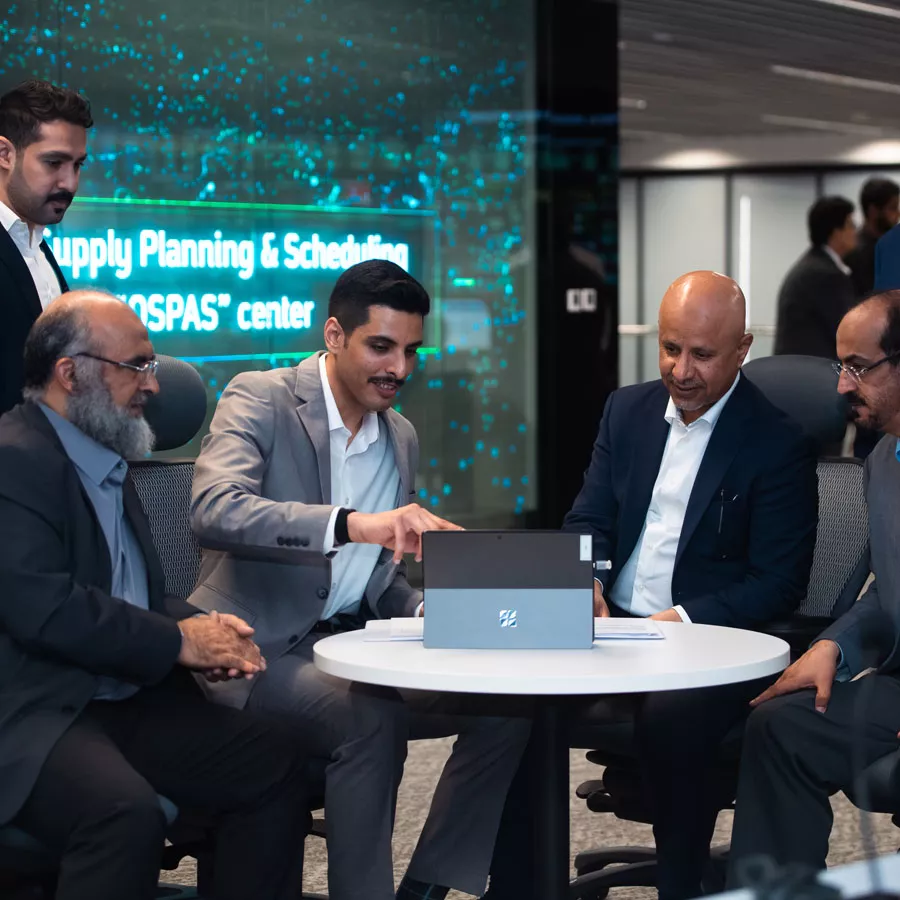
Morning meetings help our engineers get insight into operational matters.
Communication is key
There is a high-level call at 7:05 a.m. every morning, led by OSPAS Vice President Mohammed H. Al Ghamdi and often joined by executive management.
Typically, during the call, facility Directors and shift managers from each of our hydrocarbon facilities in the Kingdom report on performance and any upcoming issues that OSPAS should be aware of.
“It’s a short call but a very important one that helps ensure everything is safe across the hydrocarbon network and if there’s anything that needs to be known about for OSPAS’ support,” Albeladi says.
Then, after a broad overview, the Gas and NGL Division holds a separate meeting at 7:45 a.m. that delves into the performance of the Master Gas System network. This meeting usually lasts around 20 minutes, and once concluded, the engineers have insight into all operational matters reported across the extensive network of gas pipelines over the last 24 hours.
The role of technology
Technology plays a pivotal role in supporting OSPAS in managing vast amounts of data and making precise, real-time, and informed decisions that help our operations run smoothly.
Leveraging decades of operational experience, OSPAS has worked continuously to adopt the Fourth Industrial Revolution (4IR) technologies, integrating Artificial Intelligence (AI), real‑time data, and human expertise to reimagine its operations.
“Although technology is a powerful enabler of change, it’s our people who turn potential into progress,” Albeladi notes.
He adds, “Not only did we introduce new technologies, but we also combined them with the expertise and advanced domain knowledge of our engineers to support automating and optimizing our processes, resulting in significant time and cost savings.”
Albelaidi also notes that the OSPAS team continues to explore how cutting-edge advances in AI and machine learning can further help streamline operations.

Albeladi discusses recent performance metrics with OSPAS colleagues.
“There is potentially more to come,” Albeladi confirms. “We are just scratching the surface of what technology — and our people — can achieve together.”
Meeting KPIs
Another important part of Albeladi’s role is monitoring key performance indicators (KPIs) to help ensure OSPAS delivers energy in an optimal and reliable manner. He constantly monitors digital performance reports that are compiled and displayed on a modern, user-friendly dashboard. This dashboard can also be accessed on smartphones via a secure application, allowing engineers to check the status of items, such as crude deliveries and inventory levels.
“With the latest technologies, we are able to manage operations efficiently and resolve issues almost instantly,” Albeladi says.
Before leaving for the day, Albeladi often assists with the daily check of the Emergency Monitoring Room (EMR) — a specialized facility within OSPAS used if serious incidents occur — to ensure it is working optimally. Those in the EMR have access to live video streams and aerial views of facilities across the Kingdom, as well as an online messaging service and radios to reach key personnel on the ground.
He then hands over to the afternoon shift personnel and informs them of any work that needs to be carried out.
Although the pace of work is often relentless, Albeladi says it’s part of what drives the team.
“Everyone at OSPAS feels a strong sense of pride and purpose,” he explains. “We’re fully aware of the critical role we play in keeping the Company’s operations running smoothly, and that’s why we aim not only to perform our duties with precision, but to strive toward setting the benchmark for excellence,” he says.
More from Elements

The information in this article is provided for general informational purposes only and it reflects information available at the time of publication. It may be subject to change, and Saudi Aramco does not undertake any obligation to update or revise this content following publication.