
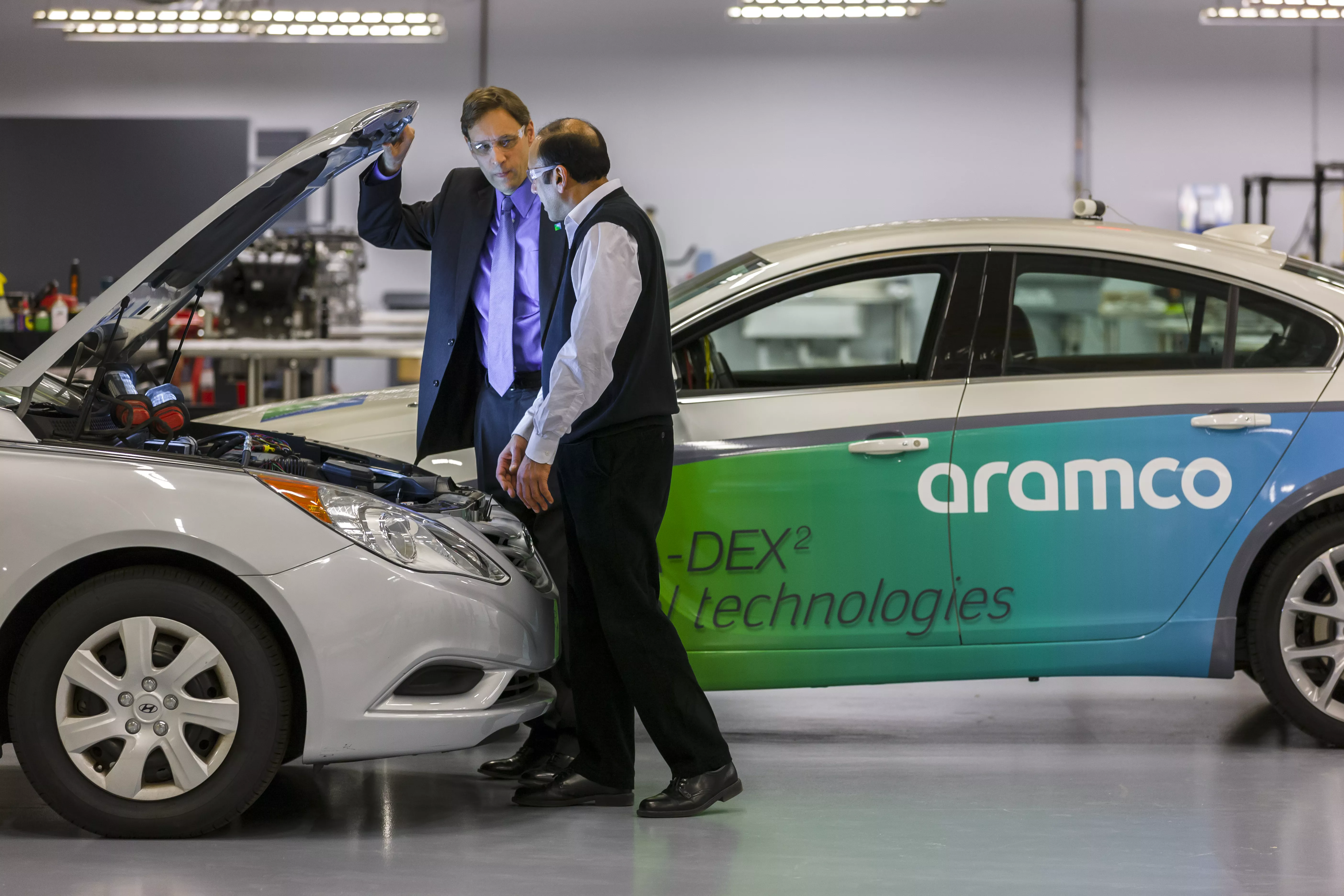
Engine technologies
For the foreseeable future the majority of cars on our roads will be vehicles powered by internal combustion engines. So, it only makes sense to make sure they are as efficient as possible.
Through our global research centers and partnerships with the automotive industry, we’re working to improve the internal combustion engine and advance game-changing transportation technologies that have the potential to significantly reduce emissions and improve fuel efficiency.
Today's engine, re-imagined
We’re approaching the emissions challenge by designing internal combustion engines (ICEs) that can produce lower levels of emissions while still delivering high efficiencies.
We believe that in the short to medium term, advanced, efficient ICEs are the most effective way we can reduce transport-associated CO2.
There are a number of variables in an ICE engine that can be altered to achieve higher efficiency and lower emissions, and our experts and scientists, from across our global research network, are working in partnerships with the automotive industry to push these advances forward.
Turbulent Jet Ignition
We’re developing an ultra-lean combustion strategy for gasoline engines using Turbulent Jet Ignition (TJI). TJI is a technology that can greatly enhance the ignition process, leading to improved fuel efficiency and reduced emissions.
The technology enables the combustion to progress in a stable manner when the fuel-air mixture has been diluted with additional air or exhaust gas.
It works by premixing a small quantity of air and fuel in a pre-chamber — a small cavity that is separate from the main combustion chamber. This mixture is then ignited, generating highly-turbulent jets of hot radicals which enter the main combustion chamber, providing a wider distribution of ignition sources than a traditional spark plug, with hundreds of times more energy.
We have developed considerable understanding of this promising combustion mode, focusing on two distinct approaches: Active and Passive.
Two approaches
Active:
A spark plug and secondary fuel injector are positioned inside the pre-chamber. This injector introduces a small quantity of fuel, which is then ignited by the spark plug to create the turbulent jet of radicals that ignite the main charge in the combustion chamber.
Passive:
No secondary injector is required as this approach relies upon the combustion chamber design and the injection strategy to guide a small quantity of air and fuel into the pre-chamber to be ignited by the spark plug.
While the two approaches leverage different hardware, both can yield greater efficiency and reduced emissions.
This technology has been successfully tested by several technology providers, and Aramco is integrating TJI into an advanced gasoline vehicle. If vehicle integrations prove successful, we hope to see it commercialized in the near future.

The potential benefits of improving engine efficiency with our TJI technology
cost effective
The hardware architecture is simple and cost effective to implement with current engine hardware.
lower emissions
The potential for higher fuel efficiency and lower pollutant emissions compared to many conventional gasoline and diesel engines.
meet regulations
TJI can assist automakers in meeting their regulatory and policy obligations.
Mobile Carbon Capture
Mobile Carbon Capture (MCC) is an innovative technology, which can lower the CO2 footprint of the transport sector.
Refined over more than a decade by our scientists, the latest variant of the technology can capture up to 40% of the CO2 emitted from a vehicle’s exhaust. The CO2 is stored on board the vehicle, and can be used in a variety of industrial and commercial applications once offloaded.
We have successfully demonstrated MCC technology in a Ford F-250 pickup truck, a midsize Toyota Camry passenger vehicle, and a Class 8 heavy-duty truck. By combining MCC with GCI and other efficiency improving technologies, we are aiming to achieve a 50% reduction in the CO2 footprint of the truck.
MCC has the potential to significantly reduce the emissions associated with freight transport, and would be especially viable when applied to captive fleets.
The aims of our Mobile Carbon Capture technology
50%
We’re targeting a 50% CO2 avoidance for this technology.
freight emissions
MCC has the potential to significantly reduce the emissions associated with freight transport.
CO2 reduction
The technology can be used in tandem with other technologies to further reduce CO2.

Global research centers
Achieving the necessary technology breakthroughs requires access to the best ideas, people, and partners around the world.

Climate challenge
For some, the idea of an oil and gas company positively contributing to the climate challenge is a contradiction. We don’t think so.