

How CCUS is supporting a lower-carbon economy
As global energy demand continues to rise, innovative solutions are playing a vital role in reducing CO2 emissions from industries, transportation and power generation.
As industries with hard-to-abate emissions seek lower-carbon pathways, Carbon Capture, Utilization, and Storage (CCUS) offers a scalable solution to reduce carbon dioxide (CO2) emissions while maintaining industrial productivity.
As industries with hard-to-abate emissions seek lower-carbon pathways, Carbon Capture, Utilization, and Storage (CCUS) offers a scalable solution to reduce carbon dioxide (CO2) emissions while maintaining industrial productivity.
Industries that are difficult to electrify — such as cement, steel, and chemicals — are responsible for approximately 16% of global CO2 emissions.1
CCUS offers one of the few options for reducing emissions from these hard-to-abate sectors without requiring a complete overhaul of existing industrial processes. CO2 is securely stored underground or utilized to prevent it from entering the atmosphere.
CCUS offers one of the few options for reducing emissions from these hard-to-abate sectors without requiring a complete overhaul of existing industrial processes. CO2 is securely stored underground or utilized to prevent it from entering the atmosphere.
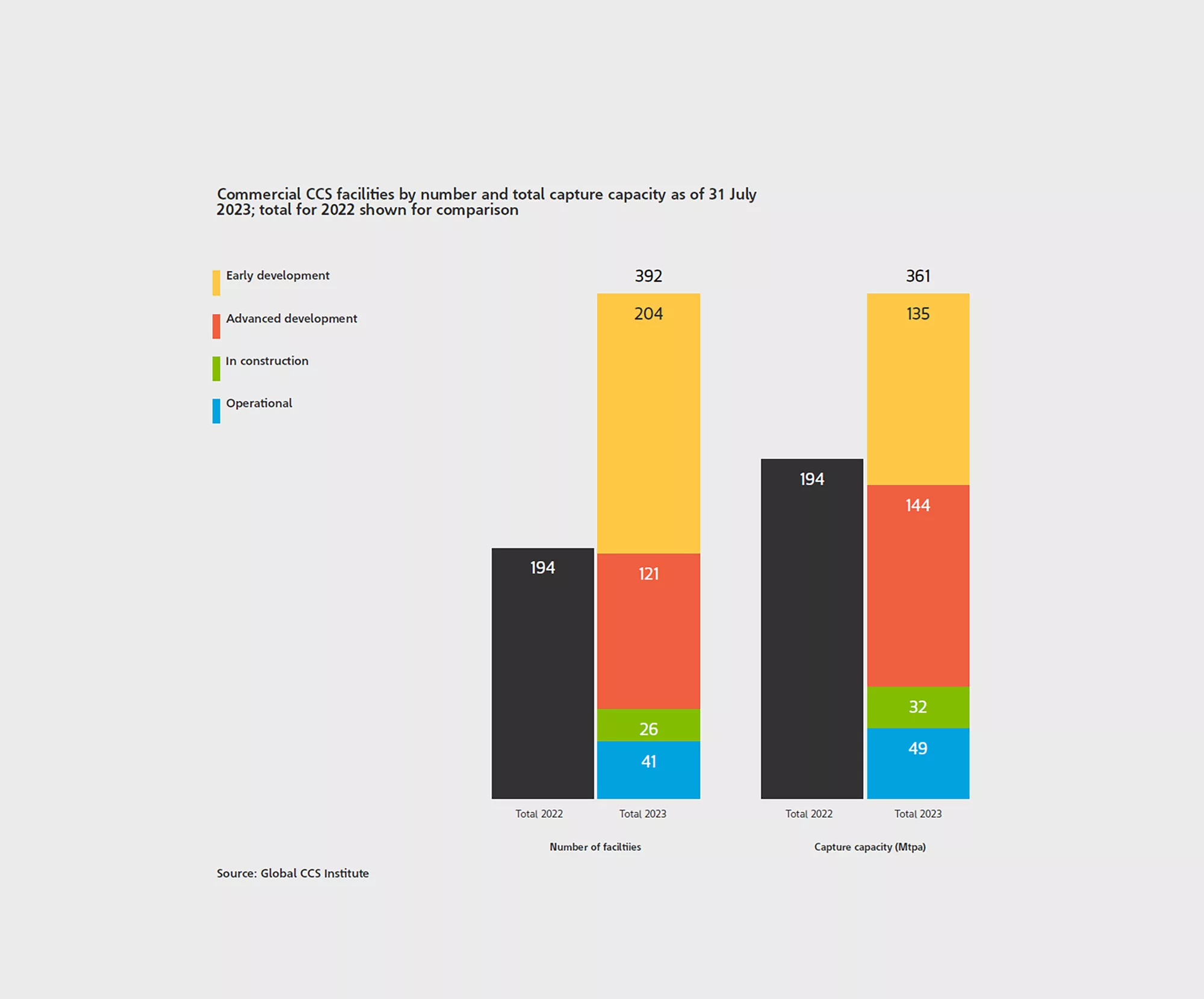
- The Global CCS Institute reports that to align with global net-zero targets, over 1.2 billion metric tons of CO2 per year must be captured by 2030.2
- Without CCUS, McKinsey & Company estimates an additional $1.5 trillion in costs for industrial decarbonization due to the need for alternative technologies.3
- The BloombergNEF CCUS Tracker (2023) projects that by 2050, 6-8 billion tons of CO2 per year will need to be captured and stored to meet net-zero goals.4
Aramco recognizes the strategic importance of CCUS in delivering both national and global climate ambitions.
Its Carbon Capture initiatives address both point-source emissions (from industrial facilities) and atmospheric CO2 removal through Direct Air Capture (DAC).
Aramco believes in supporting an orderly global Energy Transition, of which a key part is expected to be the use of CCUS. The company has committed to advancing CCUS technologies as part of its broader strategy to reduce carbon emissions and support climate ambitions.
It is investing in CCUS projects and exploring innovative solutions for CO2 utilization. Collaboration is crucial to meeting any challenge — and advancing CCUS technologies is no exception.
“We need to decarbonize existing resources and at the same time build the new. We need to take care of all stakeholders in terms of making sure that we provide affordable, sustainable, and secure energy for the whole world.”5
Amin Nasser - Aramco President & CEOTogether with a wide range of industrial, academic, and commercial partners, Aramco is helping support the carbon capture industry. From research initiatives within its dedicated centers, such as the Korean Advanced Institute of Science and Technology (KAIST) in Daejeon, South Korea, to pilot agreements with the likes of Siemens, and providing support to innovative technologies developed by companies such as Spiritus, Aramco has taken, and is continuing to take a collaborative approach to advancing CCUS.
Find out more by downloading our 2025 carbon capture report
1 https://www.weforum.org/publications/net-zero-industry-tracker-2023/in-full/steel-industry-net-zero-tracker/
2 https://www.globalccsinstitute.com/resources/global-status-report/
3 https://www.mckinsey.com/capabilities/sustainability/our-insights/spotting-green-business-opportunities-in-a-surging-net-zero-world/transition-to-net-zero/power
4 https://about.bnef.com/blog/net-zero-industry-requires-exponential-growth-from-carbon-capture-hydrogen-and-clean-power/
2 https://www.globalccsinstitute.com/resources/global-status-report/
3 https://www.mckinsey.com/capabilities/sustainability/our-insights/spotting-green-business-opportunities-in-a-surging-net-zero-world/transition-to-net-zero/power
4 https://about.bnef.com/blog/net-zero-industry-requires-exponential-growth-from-carbon-capture-hydrogen-and-clean-power/
The promise of Hydrogen